TopDissertations


What Is IRB Ethics Approval — and Why Does It Matter for Your Dissertation?
IRB ethics approval is the formal authorization your university grants before you can collect data from human participants. The Institutional Review Board reviews your research protocol to ensure your study protects people’s rights, welfare, and dignity. It’s not optional, it’s not bureaucratic busywork — it’s a legal requirement under federal regulations (primarily the Common Rule, 45 CFR 46) that applies to every study involving identifiable human data.
Here’s the reality: you cannot get retroactive IRB approval. If you start collecting data before your IRB letter arrives, that data is legally unusable. That means lost months, delayed graduation, and potentially a full dissertation rejection.
The IRB exists for a simple reason: to prevent the kinds of ethical abuses that happened in the mid-20th century. Today, your dissertation research falls under the same ethical oversight as clinical trials and behavioral studies. The IRB’s job is to make sure your study’s benefits justify any risks to participants and that consent is properly obtained.
If you’re a graduate student preparing for your dissertation research, you’re about to navigate a process that can add 4 to 12 weeks to your timeline. Understanding what the IRB actually looks for — and what trips up even careful researchers — is the difference between a smooth approval and an IRB revision cycle that eats three months of your schedule.
For a detailed procedural walkthrough, see our complete guide on how to get IRB approval for your dissertation, which covers submission portals, platform navigation, and step-by-step documentation requirements.
- IRB approval is legally required before collecting any identifiable human data — and it cannot be obtained retroactively.
- The IRB makes the final review-category decision, not you. Self-classifying as “Exempt” when you collect identifiable data triggers a downgrade.
- Most IRB submissions go through an “administrative triage” completeness check (3–5 business days) that resets your entire timeline if anything is missing.
- Your CITI training certificate has a 3-year window — students who complete it in their first year often find it expires before submission.
- Document consistency is the #1 revision trigger. Protocol, consent form, and recruitment materials must match exactly.
The Student Experience: What It Feels Like (and What Actually Goes Wrong)
Let me tell you a story. “Maria” (not her real name, but her situation was real and happened at a major university) completed her CITI training during her first year of doctoral study. Her certificate said “current” — she checked the box that said “yes” on her IRB application. Three years later, when she was ready to submit her dissertation IRB application for data collection, her CITI certificate had expired. The IRB office sent her a single email: “Please renew CITI training.” That was six weeks before her planned data collection start.
Maria isn’t unique. She’s the student you hear about after the fact, and the one you should learn from.
Here’s what most students don’t understand about the IRB process:
The IRB review process isn’t just a checklist. It’s a negotiation between what you think your study needs and what reviewers think your participants require for safety. The reviewers are not trying to make your life difficult — they’re trying to protect human subjects. But they’re also human, and they’re looking for specific things in specific places.
What IRB Reviewers Actually Look For
When an IRB reviewer reads your protocol, they’re asking three questions:
- Is this human subjects research? (If yes, full review required — regardless of whether you think the risks are minimal.)
- What could go wrong for participants? (Physical harm? Psychological distress? Legal or employment consequences? Social stigma?)
- Are the protections adequate? (Consent language? Confidentiality? Voluntary participation? Right to withdraw?)
The reviewers want you to prove you’ve thought through these questions before they do.
IRB Review Levels Explained: Expedited vs Full Board Review
Your study’s risk level determines which path it follows. This is where students first hit confusion.
| Review Level | Risk Profile | Who Reviews | Typical Timeline |
|---|---|---|---|
| Exempt | Minimal or no risk; very limited data collection | IRB staff member | 1–2 weeks |
| Expedited | Minimal risk; involves identifiable data | One or more IRB members | 2–4 weeks |
| Full Board | Greater than minimal risk or vulnerable populations | Convened IRB committee | 4–8+ weeks |
Here’s what trips up students: you don’t get to choose your review level. The IRB assigns it based on what they see in your application. If you classify your study as “Exempt” but collect identifiable names or survey responses linked to demographics, a reviewer will downgrade you to Expedited — or worse, Full Board review. That downgrade isn’t a punishment; it’s a safety check.
Full Board review is the biggest timeline risk. The committee meets monthly, and many institutions don’t hold meetings during summer or holiday breaks. If you submit in May and the next Full Board meeting is in September, that’s a three-month delay. Summer calendar traps are the single biggest cause of unexpected timeline delays.
For a comparison of research methodologies and when to choose each approach, see our guide on qualitative vs. quantitative research methods.
The Hidden Steps: What Most Students Miss
The CITI Training 3-Year Trap
The CITI Program (Collaborative Institutional Training Initiative) is the most widely accepted human-subjects research training. Most students complete it when they first enter graduate school — and most students don’t realize the certificate expires after three years.
The trap: A doctoral student finishes CITI in Year 1. Their proposal defense happens in Year 2. They begin dissertation research in Year 3. Their CITI certificate expired a year ago. The IRB requires renewal before any review begins.
The fix: Check your CITI expiration date before drafting your IRB application. If it’s within six months of expiring, renew it now. If it’s already expired, renew immediately — don’t wait for the IRB to tell you.
Your faculty advisor also needs current CITI certification and will be listed as the Principal Investigator on your application. You cannot list yourself as PI at most universities.
Administrative Triage: The Timeline Reset
This is the single most disruptive hidden step in the IRB process. Most IRBs run a 3–5 business day completeness check before substantive review begins. If your submission is missing even one document — a single missing consent form page, an unsigned signature line, an outdated template — the entire timeline resets. It doesn’t pause. It starts over.
Think of it like this: you submit Day 1. The IRB office checks Day 4 and finds you forgot the recruitment flyer. Day 5, they send you a “request for more information.” You submit the missing piece on Day 12. Your clock restarts from Day 12. That’s four weeks of actual review time lost, not because your research was unethical, but because a single document was incomplete.
Pre-submission consultations exist for this reason. Many IRB offices offer a pre-review meeting (sometimes called a “pre-triage” consultation). Schedule one. It’s free, it takes 15 minutes, and it can catch completeness issues before they cost you a full review cycle.
The Self-Exemption Myth
Graduate students cannot decide their own project is exempt. You must submit an application, and the IRB makes the final category determination. Even if you believe your study involves zero risk — surveys with anonymous responses, classroom observations — the IRB still needs to review and formally designate it as Exempt.
If you collect identifiable data (names, survey responses linked to demographics, interview quotes that could identify speakers) and classify as Exempt, reviewers will downgrade you to Expedited or Full Board review. This is the most common reason students experience unexpected timeline delays.
Document Consistency: Why It’s the #1 Revision Trigger
When an IRB reviewer opens your submission, they check for one thing above all else: document consistency. Your protocol, consent form, and recruitment materials must match exactly.
Here’s what consistency actually means in practice:
| Section | What Must Match |
|---|---|
| Sample size | Protocol says “50 participants,” consent form says “50 participants,” recruitment flyer says “50 participants” |
| Data collection methods | Protocol describes phone interviews lasting 30 minutes; consent form must mention phone interviews and 30-minute duration; recruitment materials must accurately describe the same process |
| Risk descriptions | Protocol lists “minimal psychological risk”; consent form must describe the same risk level; recruitment materials cannot promise “no risks whatsoever” |
| Confidentiality procedures | Protocol describes encrypted storage; consent form must explain the same storage method |
A student at a large public university reported spending three weeks revising her IRB application because her recruitment email mentioned “30-minute interviews” but her protocol said “45-minute interviews.” Three weeks. For a single numbers mismatch.
The consent form should be drafted LAST. Draft your protocol first, finalize it, then draft the consent form to match. If you draft the consent form first, you’ll be constantly rewriting it as the protocol changes.
The Maria Case Study: What Happens When Things Go Wrong
Here’s a real-world scenario based on a documented case from the Dissertation Horse:
Maria, a doctoral student in education research, designed a study examining teacher burnout. Her protocol involved 40 semi-structured interviews with K-12 teachers. She drafted everything — protocol, consent form, interview guide — and submitted through her university’s IRB portal.
What went wrong:
-
Consent form drafted too early. Maria drafted her consent form before her interview guide was finalized. The interview guide included questions about workplace stress that Maria added weeks later, but these weren’t reflected in her consent form’s risk section.
-
Recruitment materials inconsistent. Her recruitment email promised “no personal questions” but her interview guide asked about specific workplace incidents involving named colleagues.
-
Faculty PI confusion. Maria listed herself as the PI instead of her faculty advisor. The IRB office rejected the application outright and required a full resubmission.
The result: Maria’s timeline stretched from an estimated 3 weeks to 12 weeks. Her data collection was delayed by four months.
What she should have done:
- Draft the protocol first, finalize it, then write the consent form to match exactly
- Draft recruitment materials after the interview guide was set
- List her faculty advisor as the PI (required at her institution)
- Request a pre-submission consultation to catch inconsistencies before official review
This case study illustrates why document consistency isn’t just paperwork — it’s the difference between a smooth approval and an IRB revision cycle that costs months.
The IRB Submission Checklist: Your Practical Checklist
Use this checklist before hitting “submit”:
- [ ] CITI training: Current certification (check expiration date) for both you and your faculty PI
- [ ] Faculty PI confirmed: Your advisor agrees to serve as Principal Investigator
- [ ] Research protocol: Questions, methodology, sampling plan, data analysis plan — all written and finalized
- [ ] Informed consent form: Written in plain language (8th-grade reading level), drafted after protocol is finalized
- [ ] Recruitment materials: Email invitations, flyers, social media posts — all drafted and consistent with protocol
- [ ] Data collection instruments: Survey questions, interview guides, observation checklists
- [ ] Consistency check: Sample size, procedures, risk descriptions, and confidentiality language match across all documents
- [ ] Data management plan: Encrypted storage, access permissions, retention period, destruction protocol
- [ ] Post-proposal hearing: Report ready if your institution requires post-proposal IRB approval
- [ ] Pre-submission consultation: Scheduled if available at your IRB office
- [ ] Submission portal: Confirmed login credentials and accepted file formats
The IRB Revision Cycle: What to Expect
Expect your first submission to not be approved immediately. This is normal. This is expected. This is the process.
When reviewers send you a “Request for Revisions” memo, they’re not rejecting your research — they’re asking you to clarify protections for participants. The most common revision triggers:
| Revision Reason | What to Fix |
|---|---|
| Consent language too intimidating | Add a plain-language summary at the top; simplify technical terms |
| Confidentiality unclear | Specify exactly where data is stored, who has access, encryption method |
| Recruitment language vague | Detail the exact text participants will see; explain how they respond |
| Sample size justification missing | Add a power analysis or cite peer-reviewed methodology sources |
| Sensitive questions unexplained | Justify why each question is necessary; describe mitigation strategies |
How to respond professionally:
- Address each reviewer comment line-by-line
- Use tracked changes or highlighting to show exactly what you changed
- Keep your tone respectful — thank reviewers for their feedback
- Submit clean, final versions alongside a revision memo
Most revision cycles add 2–4 weeks. Students who respond thoughtfully and respectfully often speed approval dramatically.
IRB Proposal Defense Timeline: When to Submit
Your IRB submission timing should anchor your entire dissertation schedule — not the other way around.
| Data Collection Start | Latest IRB Submission |
|---|---|
| September | June (4 weeks before) |
| January | October (4 weeks before) |
| May | February (4 weeks before) |
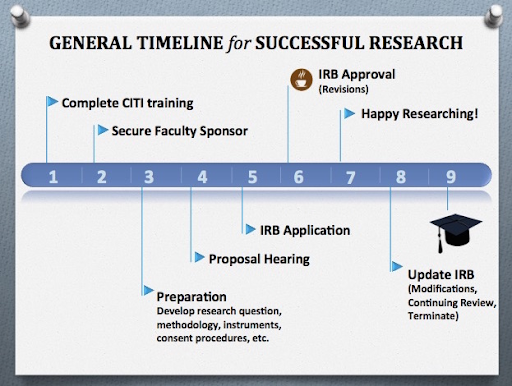
The realistic timeline: Budget 6–8 weeks from CITI training to submission, then 4–12 weeks for approval depending on review level. That’s a total of 10–20 weeks from training completion to approval. Factor in 1–2 additional weeks for revisions.
Important: At many institutions, full dissertation research IRB approval must be dated after your proposal defense. Pre-dissertation research (pilot studies) may be approved before your proposal defense, but the IRB letter for dissertation research must come post-proposal to satisfy graduation requirements. Check your institution’s graduate handbook for the exact sequence.
What We Recommend
Here’s what most students should do when preparing for IRB approval:
Start early, but start strategically. Don’t rush through CITI training in your first year — plan your training so your certificate doesn’t expire before submission. If you’re three years out from entering graduate school, check the expiration calendar before you begin.
Draft in the right order. Protocol first → finalize it → draft consent form → draft recruitment materials. This order prevents the document inconsistencies that cause revision cycles.
Schedule a pre-submission consultation. If your IRB office offers one, use it. It’s free, it takes 15 minutes, and it can save you four weeks of timeline resets.
Budget for revisions. Even careful students receive a “request for revisions” on first submission. Budget 2–4 weeks beyond your estimated timeline.
If you’re overwhelmed, get help. Navigating IRB approval is one of the most stressful parts of dissertation research. Our team of PhD-level researchers can help you draft protocols, design consent forms, and navigate the process efficiently. Get a free consultation and avoid the timeline pitfalls that trip up so many students.
Managing IRB Stress Alongside Dissertation Research
The IRB process adds a significant cognitive load to an already demanding dissertation journey. If you’re feeling the weight of documentation, timelines, and ethical compliance, you’re not alone. Our guide on dissertation stress management offers practical strategies for maintaining mental health throughout the research process.
Final Thoughts: IRB Approval Is a Timeline Milestone, Not a Checkbox
The IRB ethics approval process feels like a barrier. It’s not. It’s a structured, predictable process that protects your participants and your research. Treat it as a timeline milestone, not a procedural checkbox. Budget for it, plan backward from it, and don’t start data collection until your approval letter arrives.
The students who succeed aren’t the ones who rush through the paperwork. They’re the ones who understand what the reviewers are looking for, draft their documents in the right order, and expect revisions before approval.
Related Guides
- How to Get IRB Approval for Your Dissertation — procedural walkthrough of submission portals, platform navigation, and documentation requirements
- Dissertation Stress Management Guide — coping strategies for the research process
- How to Write a Dissertation Methodology Chapter — align your methodology with IRB requirements
- Systematic Literature Review PRISMA Guide — literature review techniques that complement empirical research
Need expert help with your IRB application or dissertation? Our PhD-level researchers specialize in protocol writing, consent form design, and IRB navigation. Get a free consultation or explore our dissertation writing services.
Sources
- The Dissertation Coach — How to Prepare an IRB Application (Oct 2025)
- Dissertation Horse — IRB Approval Guide
- University of Michigan HRPP — Informed Consent Guidelines and Templates
- CASRAI — IRB REC Approval Process
- WCG Clinical — How Long Does IRB Approval Take?
- Ohio University — IRB Compliance Page
- PMC/NIH — Research Ethics and IRB Processes (Capili, 2024)
- Teachers College, Columbia University — General Timeline for Successful IRB Approval