 TopDissertations

What Is IRB Approval and Why Does Your Dissertation Need It?
If your dissertation involves collecting data from people — surveys, interviews, observations, focus groups — you’ll need IRB approval before you recruit a single participant. This isn’t optional, and there are no retroactive approvals.
The Institutional Review Board (IRB) is a university committee established to protect the rights and welfare of human research participants. Its mandate comes from federal regulations, primarily the Common Rule (45 CFR 46), which requires any institution receiving federal research funding to review studies involving people. Even if your university doesn’t receive federal funding, most institutions maintain an IRB because ethical standards, graduation requirements, and institutional policy all demand oversight.
IRB approval is required whenever your research meets both of these criteria:
- It is a systematic investigation designed to contribute to generalizable knowledge (your dissertation fits this by definition)
- It involves human subjects — living individuals about whom you collect identifiable data or interact with them
Common dissertation examples that require IRB approval:
- Interview-based qualitative studies
- Survey research collecting demographic or opinion data
- Focus groups and classroom observations
- Comparative studies involving human performance
- Pilot studies that feed into your main dissertation data
Common examples that do not require IRB approval:
- Analysis of existing, fully de-identified datasets
- Literature-based or theoretical dissertations with no data collection
- Case histories used strictly for clinical education purposes
If you’re unsure whether your study qualifies, contact your faculty advisor or IRB office directly. They make the final determination — don’t guess.
Understanding the Three Levels of IRB Review
Your review level determines who evaluates your application and how long the process takes. The IRB assigns your study based on the risk level to participants.
| Review Level | Risk Profile | Who Reviews | Typical Timeline |
|---|---|---|---|
| Exempt | Very low risk; minimal data collected | IRB staff | 1–2 weeks |
| Expedited | Minimal risk; involves identifiable data | One or more IRB members | 2–4 weeks |
| Full Board | Greater than minimal risk; vulnerable populations | Convened IRB committee | 4–8+ weeks |
Here’s what most students don’t understand: the IRB makes the final review-category determination, not you. If you self-classify your study as “Exempt” but collect identifiable information, the reviewer may downgrade your application to Expedited or Full Board review. This is the most common reason students experience unexpected timeline delays.
Exempt does not mean you skip review — it means a staff member verifies your study fits a federal exemption category. The IRB still makes a formal determination.
Full Board review requires you to wait for a scheduled committee meeting, which typically happens once per month. Many institutions don’t hold full board meetings during summer or holidays, so missing a deadline can mean a 3-month delay.
CITI Training: The Hidden Timeline Risk
Before you submit anything, you need to complete your institution’s mandatory human-subjects research training. The most widely accepted program is the CITI Program (Collaborative Institutional Training Initiative), which offers courses in:
- Social and Behavioral Research
- Defining Research with Human Subjects
- Federal Regulations
Your CITI certificate must be current — typically within the past three years. This is critical for doctoral candidates whose research spans multiple years. If your certificate expires before your IRB approval process is complete, you’ll need to renew it before you can resubmit.
The 3-year expiration trap is real: A student who completes CITI training in their first year of graduate study may find the certificate expires before their dissertation research begins. Plan ahead — check your certificate’s expiration date before starting the IRB application.
Your faculty advisor also needs current certification and will be listed as your Principal Investigator (PI) on the application. The IRB does not accept student-led applications without faculty oversight.
Pro tip: Some universities use alternative training programs like AAAHR. Check your IRB office’s website for a list of accepted training providers.
Required Materials: Your IRB Submission Checklist
Your application won’t be reviewed unless you submit every document the IRB needs. The single most common error students make is incomplete attachments.
| Required Document | What It Should Include |
|---|---|
| Research protocol | Research questions, methodology, sampling plan, data analysis plan |
| Informed consent form | Study purpose, procedures, risks, confidentiality, voluntary participation, contact info |
| Recruitment materials | Email invitations, social media posts, flyers, scripts |
| Data collection instruments | Survey questions, interview guides, observation checklists |
| CITI certificates | Current certification for you and your faculty PI |
| Data management plan | Storage location, access permissions, retention period, encryption method |
Informed Consent Form
Use the consent form templates provided by your university’s IRB office — these are usually available in Mentor IRB, Cayuse, or your institution’s submission portal. The HHS SACHRP minimal-risk consent models offer excellent guidance on required consent elements.
Your consent form must explain in plain language:
- The purpose and duration of the study
- What participants will be asked to do
- Any potential risks (physical, psychological, social, financial)
- How confidentiality and data storage will be maintained
- The voluntary nature of participation and the right to withdraw without penalty
- Contact information for your research team and the IRB
The HHS model consent form shows exactly how a proper consent form should look. Check HHS SACHRP consent form templates for reference.
Recruitment Materials
The IRB cannot approve a study if they cannot review the materials participants will see. Include every email, flyer, and post text. The IRB reviews these to ensure they don’t contain coercive language or misleading claims about the study. Before drafting these materials, make sure your research protocol and methodology chapter are finalized — inconsistencies between them will trigger revision cycles. See our research proposal writing guide for best practices.
Data Management Plan
“I will keep data safe” is insufficient. The IRB needs specifics: encrypted storage, password protection, who has access, and how long you will retain the data. Be concrete about every element. See our data analysis methods guide for details on data handling workflows.
Understanding Vulnerable Populations and Special Considerations
Your study may require additional protections if it involves vulnerable populations. According to the Belmont Report principles (respect for persons, beneficence, justice), certain groups need enhanced oversight.
Vulnerable populations include:
- Children and minors (requires assent forms and additional protocols)
- Prisoners
- Cognitively impaired individuals
- Refugees or displaced persons
- Economically disadvantaged individuals
- Students in your own classes (potential coercion risk)
Multi-site research — If you’re conducting research at a hospital, school district, or corporation, you need a Letter of Site Authorization before IRB approval. This means both your home institution and the external site must approve the study.
Admin data handling — If you’re using administrative data (grades, HR records, etc.), you may need a Data Use Agreement (DUA) with the data provider. Check your IRB office’s guidance on data sharing.
The IRB Submission Process Step-by-Step
Step 1: Complete CITI Training
Start here — don’t submit an application with an expired or incomplete training certificate. CITI modules typically take 10-20 hours to complete, and you’ll need the certificate before you can begin the IRB application.
Step 2: Prepare All Materials
Draft your consent form, recruitment materials, and instruments early. The IRB can’t approve what it can’t review. Many students lose weeks because they submit before these materials are ready.
Step 3: Get Faculty Advisor Approval
Your faculty advisor must serve as your Principal Investigator on the IRB application. Submit draft materials to your advisor for review, revise based on feedback, and get formal sign-off (signature or electronic approval) before listing them as PI on the application portal. Before you submit, make sure your methodology chapter — whether qualitative, quantitative, or mixed methods — clearly aligns with what you’re asking the IRB to approve. See our qualitative vs quantitative research methods guide for alignment tips.
At many institutions, your faculty sponsor must electronically “accept” your protocol in their institutional system (such as Mentor IRB) before the IRB begins review. Without this step, your application stalls.
Step 4: Submit Through Your Portal
Most universities use an online submission portal. Common platforms include:
- Cayuse — Used by many institutions for all IRB submissions
- Mentor IRB — Used by Columbia University and others
- IRB Manager — A widely adopted commercial platform
- IRBNet
- Institutional email-based submission — Some smaller universities
Step 5: Understand the Administrative Triage
Here’s where most students get caught off guard: most IRBs run an initial 3-5 business day completeness check before substantive review begins. If your submission is incomplete, the entire timeline restarts. It doesn’t just pause — it resets.
A poorly prepared submission doesn’t mean your research is unethical; it means the IRB needs more information. But that “trig” to “triage” restart can cost you weeks. Consider requesting a pre-submission consultation at your IRB office — many offices offer this, and it can catch completeness issues before they cost you a full review round.
Step 6: Post-Proposal Hearing Timing
At many institutions, you can submit pre-dissertation research (such as pilot studies) before your proposal hearing. However, full dissertation research must be submitted after your proposal hearing is successfully completed. The IRB approval letter for dissertation research must be dated post-proposal to satisfy graduation requirements.
Teachers College at Columbia University specifies that an IRB approval letter for pre-dissertation research will not satisfy the Office of Doctoral Studies’ graduation requirements. Only the post-proposal hearing approval letter does. Check your institution’s graduate handbook for the exact sequence. If you’re preparing for your proposal defense, our dissertation defense preparation guide has tips on nailing it.
How to Handle IRB Reviewer Feedback (Revisions That Speed Approval)
Expect your first submission to not be approved immediately. This is normal and expected. IRB reviewers almost always request modifications. This is not a rejection — it’s part of the process.
Typical Revision Scenarios
| Common Feedback | What to Do |
|---|---|
| Clarify how you will protect confidentiality | Add specific storage procedures, encryption methods, and data access limits |
| Revise consent language to be less intimidating | Simplify technical terms; add a plain-language summary at the top |
| Expand recruitment instructions | Detail the exact text of emails, posts, and participant response steps |
| Justify sensitive questions | Explain why the question is necessary and how you will mitigate discomfort |
| Address sample size justification | Cite power analysis or peer-reviewed methodology sources |
How to Respond Professionally
When you receive a Request for Revisions memo:
- Address each item clearly and directly in your response
- Highlight or annotate changes in revised documents using tracked changes
- Keep your tone professional — thank reviewers for their feedback
- Submit clean, final versions of all updated documents alongside a revision memo
The Teachers College IRB recommends using their memo template to keep your responses organized. Students who address reviewer feedback thoughtfully and respectfully often speed approval dramatically.
IRB Timeline Planning: When to Submit for Your Review
This is where most students fail — they treat IRB approval as a quick procedural step instead of a timeline milestone. Don’t do this.
Realistic Timeline Ranges
| Review Level | Estimated Wait | Notes |
|---|---|---|
| Exempt | 1–2 weeks | No committee meeting required |
| Expedited | 2–4 weeks | Reviewer may schedule a brief conference call |
| Full Board | 4–8+ weeks | Must align with monthly committee meeting schedules |
Factor in 1–2 additional weeks for revisions. Many students budget a 4–6 week window from first submission to approval.
The Summer Calendar Trap
Full board meetings don’t happen during summer holidays at many institutions. If you’re planning to submit in June and need Full Board review, you may not see a meeting until September — a 3-month delay. Plan backward from your data collection start date.
When to Submit
| Data Collection Start | Latest IRB Submission Date |
|---|---|
| September | June (4 weeks before) |
| January | October (4 weeks before) |
| May | February (4 weeks before) |
Budget 6-8 weeks from CITI training completion to IRB submission, then budget 4-12 additional weeks for approval depending on review level. IRB approval should anchor your dissertation data collection schedule — not the other way around.
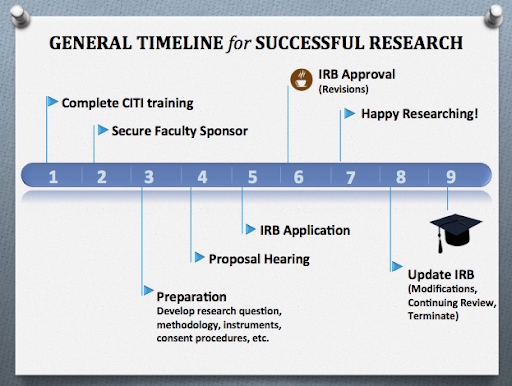
The Teachers College IRB at Columbia University estimates budgeting at least four weeks for the entire process, from drafting materials to final approval. See the Columbia IRB timeline infographic for a visual guide.
IRB approval timeline for doctoral research (Teachers College, Columbia University). Source: tc.columbia.edu/institutional-review-board.
Your IRB Approval Checklist
Use this checklist as you prepare:
- [ ] CITI training completed and certificate current
- [ ] Faculty sponsor confirmed and notified
- [ ] Research protocol written with all details included
- [ ] Consent form written in plain language (8th-grade reading level)
- [ ] Recruitment materials drafted
- [ ] Data collection instruments ready
- [ ] All documents consistent across protocol, consent, and recruitment
- [ ] Post-proposal hearing report ready for upload (if required)
- [ ] Pre-submission meeting scheduled (if available)
- [ ] Submission portal credentials confirmed
- [ ] Data management plan written (encryption, access, retention, destruction)
Critical Rules to Remember
IRB approval cannot be retroactive. Even if a student unknowingly collected data before getting approval, that data cannot be used. Conducting research without IRB approval is a violation of federal regulations.
The IRB makes the final review-category determination, not you. Don’t self-classify as Exempt if your study collects identifiable information — the reviewer will downgrade your application and delay approval.
Consistency across all documents matters. Your sample size, procedures, and consent language must match in your protocol, consent form, recruitment materials, and IRB application form. Inconsistencies trigger revision cycles.
Conclusion: Your Next Steps
The IRB approval process is often intimidating for first-time researchers, but it’s structured, predictable, and manageable when you prepare thoroughly. Here’s what to do:
- Complete CITI training early — don’t wait. Check your certificate expiration date.
- Draft all materials before submitting — consent forms, recruitment materials, instruments, data management plan.
- Get faculty advisor approval — they must serve as your Principal Investigator.
- Budget realistic timelines — 4-6 weeks from submission to approval minimum, longer for Full Board review.
- Expect revisions — respond professionally to every reviewer comment.
- Submit after your proposal hearing — if your institution requires post-proposal approval for graduation.
IRB approval is a timeline milestone that anchors your dissertation plan — not a procedural checkbox. Treat it as such, and you’ll move through the process efficiently.
Need help with your IRB application or dissertation research? Our team of PhD-level researchers can help you draft protocols, design consent forms, and navigate the IRB process. Get a free consultation and ensure your research meets the highest ethical standards.
Looking for expert academic writing support? Explore our dissertation writing services — our team can assist with research proposals, methodology chapters, consent forms, and the full dissertation process.
Sources
- The Dissertation Coach — IRB Application Guide (Jessica Parker, EdD, Oct 2025)
- Teachers College IRB — Doctoral Dissertation Research Guide (Columbia University)
- HHS SACHRP — Minimal-Risk Consent Form Models (U.S. Department of Health and Human Services)
- CASRAI — How Long Does IRB Approval Take?
- SJSU IRB — Review Types and Timelines
- J-PAL — IRB Proposals (vulnerable populations, Belmont Report)