 TopDissertations


What Is a Dissertation Topic (and Why It Matters)
A dissertation topic sits at the intersection of three things: your interest, academic relevance, and feasibility. If any of those three pillars is missing, the topic will be unstable.
Think of it this way. A topic that’s only interesting but not feasible will waste months of data collection. A topic that’s only feasible but not interesting will drain your motivation. A topic that’s interesting and feasible but not relevant to existing scholarship won’t justify the research.
A good dissertation topic is specific, researchable, original enough to matter, and scoped tightly enough that you can actually finish it within the expected timeline. It connects to existing scholarship without being a replication. It’s narrow enough for depth but broad enough to find sources.
Source: Nerdpapers, 2026.
Before we dive into the step-by-step framework, here are the core principles you need to hold onto:
- Read for gaps, not topics. A gap gives your research purpose. It’s what justifies the work and tells your committee why your dissertation matters. Read your literature to find what’s unresolved, not what’s interesting.
- Compress your topic into one sentence. ThesisAI’s one-sentence test is a practical checkpoint: if you can’t describe your topic clearly in one sentence, it’s not yet a topic — it’s still an area.
- Evaluate every candidate with the FINER framework. Feasible, Interesting, Novel, Ethical, and Relevant. A topic that fails any of these checks will cost you time and stress down the road.
- Scope expectations differ by degree. A master’s topic demonstrates competence. A PhD topic contributes new knowledge. Keep your scope aligned with what each degree level actually requires.
- Start narrowing early. The most common reason dissertation projects stall is scope creep. Learn the broad-to-narrow process before you commit.
The Step-by-Step Framework for Choosing a Dissertation Topic
Here’s the practical process, drawn from Editage’s seven-step framework, ThesisAI’s pressure-testing approach, and Nerdpapers’ nine-step selection process:
Step 1 — Identify Your General Area of Interest
Start with a broad area. It doesn’t need to be precise yet. If you’re in education, your area might be “technology integration in classrooms.” If you’re in business, it might be “organizational behavior and leadership.”
Don’t second-guess your interest at this stage. Pick the area that genuinely excites you, because you’ll be living inside this topic for months.
Action: Write down two or three areas that feel intellectually exciting. You’ll evaluate them later.
Step 2 — Conduct a Preliminary Literature Review
Now you move from general area to specific subfield. Read recent peer-reviewed articles, book chapters, and dissertations in that subfield. Look for:
- Themes and debates that keep appearing
- Methodological approaches that dominate the field
- Limitations or gaps noted by other researchers
- Questions that haven’t been answered
At this stage, you’re not trying to choose a topic yet. You’re trying to understand what the field looks like.
Step 3 — Identify the Research Gap
This is the most important step. The gap is what makes your dissertation necessary. It’s not a topic — it’s a problem that hasn’t been solved, a population that hasn’t been studied, a context that hasn’t been tested, or a method that hasn’t been applied.
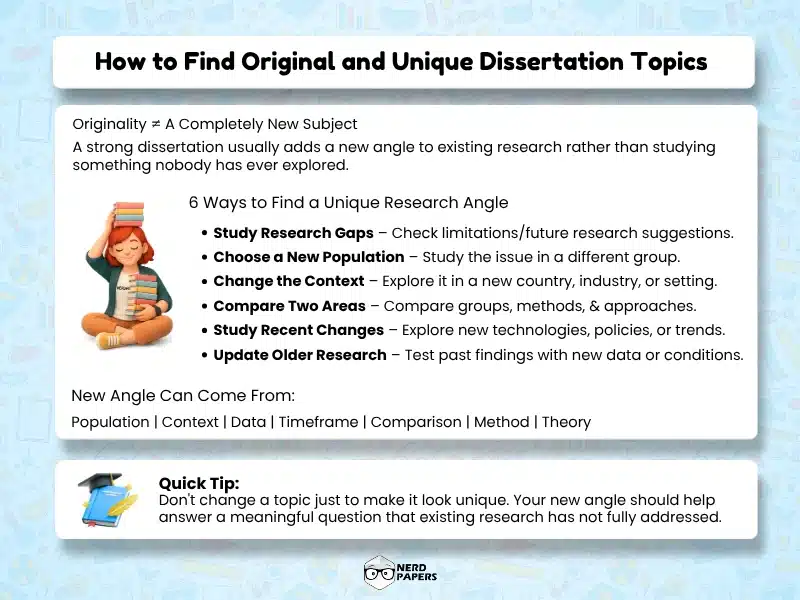
Nerdpapers outlines six practical pathways to finding originality:
- Limitations of recent studies — many papers note their own limitations at the end; those are goldmines for new research
- New population — apply an existing study to a different demographic
- Different context — test a well-known theory in a new setting (e.g., rural vs. urban, developing vs. developed countries)
- Meaningful comparison — compare two groups, interventions, or policies that have never been compared
- Recent change — explore how a recent event (AI adoption, pandemic, policy shift) reshaped the phenomenon
- Revisit earlier findings — test an older theory with new data or new methods
The gap gives your research purpose. It’s not enough for a topic to be interesting — it has to be necessary.
Step 4 — Narrow Your Scope
This is where most students get stuck. A topic like “artificial intelligence in education” is far too broad. You need to narrow it down to a specific research question.
The narrowing process looks like this:
- Subject → Education
- Broad area → Technology integration
- Specific issue → AI tools in teaching
- Population / context → Undergraduate students in public universities
- Focused topic → “The effect of AI writing assistants on revision quality among undergraduate students”
Methodology Hub provides ten worked examples showing how to go from bad → good → better topic statements. I’ll walk you through the progression right after this section.
Step 5 — Formulate Your Research Question
A research question is what your dissertation actually answers. It should be specific, measurable, and aligned with your gap.
Strong examples:
- “How does remote work flexibility affect employee retention rates in tech companies?”
- “What are the barriers to mental health service utilization among rural college students?”
- “Does AI-generated feedback improve student revision quality compared to traditional instructor feedback?”
Weak examples:
- “What is remote work?” (too broad, descriptive)
- “Why do people work?” (vague, unanswerable)
Your research question should point toward a clear methodology: will you collect survey data? Interview participants? Run an experiment? Analyze existing datasets?
Step 6 — Consult Your Supervisor
This step is non-negotiable. Even if your supervisor is not deeply involved in daily supervision, you need their approval on feasibility, relevance, and scope. They’ve seen hundreds of dissertations and can spot scope problems instantly.
Bring your narrowed topic, your research question, and a brief methodology sketch to the meeting. Ask specific questions:
- “Is this scope realistic for the expected timeline?”
- “Does this contribution meet master’s / PhD expectations?”
- “What are the common pitfalls with this type of research?”
Step 7 — Test Feasibility (The FINER Check)
Before you commit, run your topic through the FINER evaluation framework adapted from ThesisAI:
F — Feasible: Do you have access to the data, the population, the funding, and the time? If you need a database you can’t access, your topic is not feasible.
I — Interesting: Will you stay motivated through data collection, analysis, and writing? This is your topic for six months to two years. Make sure it matters to you.
N — Novel: Is there a real gap? Novelty doesn’t mean completely unexplored — it means your angle, population, context, or method adds something new.
E — Ethical: Can this study pass ethics review? Some topics require special permission (medical records, children’s data, corporate confidentiality). If ethics approval is unlikely, the topic fails.
R — Relevant: Does this matter to your field? Relevance connects your topic to existing scholarship, professional practice, or policy.
Here’s a practical FINER evaluation matrix you can use to compare multiple topic candidates:
| Criterion | Topic A | Topic B | Topic C | Red Flag Example |
|---|---|---|---|---|
| Feasible | ✅ Survey data available | ✅ Existing dataset | ✅ Interview access secured | ❌ Population inaccessible or unethical to recruit |
| Interesting | ✅ Core interest area | ⚠️ Peripheral interest | ✅ Strong personal connection | ❌ Topic you’re only doing because it sounds good |
| Novel | ✅ New context + theory | ✅ New population | ⚠️ Slight methodological twist | ❌ Replication without twist or new angle |
| Ethical (ethics review ready) |
✅ IRB clearance likely | ⚠️ Needs corporate approval | ✅ Standard IRB pathway | ❌ Sensitive data without clearance plan |
| Relevant | ✅ Directly addresses gap | ✅ Addresses practical problem | ⚠️ Relevant but tangential | ❌ Fascinating but disconnected from literature |
If a topic fails Feasible or Ethical, don’t proceed. Those are structural blockers that no amount of writing skill can fix.
Discipline-Specific Topic Examples
Here are topic examples organized by discipline. Each section includes 15 examples to help you understand the range of possibilities and the level of specificity expected.
Education
- The effect of AI writing assistants on revision quality among undergraduate students
- Teacher burnout predictors in high-poverty secondary schools: a longitudinal analysis
- Remote learning equity gaps: technology access and academic outcomes in rural districts
- Peer feedback versus instructor feedback on ESL writing proficiency
- Implementation fidelity of trauma-informed practices in K-12 schools
- The impact of gamified mathematics instruction on student confidence
- School counselor caseloads and student mental health referral rates
- Culturally responsive pedagogy adoption in STEM classrooms
- University student cheating: prevalence, motivation, and academic consequence
- Early childhood intervention programs and long-term literacy outcomes
- The effect of flipped classrooms on college science exam performance
- Parental involvement and middle school math achievement: a mixed-methods study
- Special education curriculum modifications and their impact on standardized test scores
- The relationship between school climate and teacher retention in urban districts
- Digital literacy instruction and its effect on high school reading comprehension
Business / Management
- Generative AI adoption and managerial decision-making in mid-size firms
- Remote work flexibility and employee retention rates in technology companies
- Supply chain resilience strategies during geopolitical disruption
- Consumer trust in brand sustainability claims: measuring greenwashing perception
- The impact of hybrid work models on internal team communication patterns
- Executive leadership development programs and their ROI
- Corporate board gender diversity and firm innovation output
- The effect of gig economy platforms on traditional retail employment
- Cross-cultural negotiation strategies in international M&A deals
- Employee burnout predictors in healthcare management
- The relationship between corporate social responsibility and consumer brand loyalty
- AI-driven customer service chatbots and customer satisfaction scores
- Venture capital funding patterns for female-founded startups
- The impact of regulatory compliance costs on small business growth
- Organizational culture change during technology transformation initiatives
Nursing / Healthcare
- Nurse burnout predictors in emergency departments: a mixed-methods study
- Patient satisfaction with telehealth versus in-person primary care visits
- The effect of nursing staffing ratios on patient readmission rates
- Healthcare disparities in rural vs. urban diabetes management outcomes
- The impact of AI diagnostic tools on clinician decision-making confidence
- Patient adherence to post-surgical rehabilitation programs
- Mental health service utilization barriers among college students
- The effect of patient education interventions on medication compliance
- Telehealth adoption and its impact on rural hospital utilization
- Healthcare worker turnover predictors during and after the pandemic
- The relationship between hospital workload and diagnostic error rates
- Cultural competence training effects on patient communication quality
- The impact of insurance coverage changes on chronic disease management
- AI-assisted triage systems and emergency department wait times
- Patient-reported outcomes after minimally invasive vs. open surgery
Psychology
- Social media usage patterns and adolescent anxiety symptoms
- The relationship between remote work isolation and job satisfaction
- Mindfulness interventions and their effect on college student stress
- Gender differences in help-seeking behavior for mental health
- The impact of peer support groups on recovery from substance use
- Cognitive behavioral therapy outcomes for depression: a meta-analysis
- The effect of sleep quality on executive function in older adults
- Trauma exposure and resilience factors in first-year college students
- Parenting style and its association with adolescent risk-taking behavior
- The relationship between economic stress and family communication quality
- Attention deficit patterns in adults with undiagnosed ADHD
- The effect of group therapy versus individual therapy on social anxiety
- Childhood adversity and adult coping strategy selection
- Social media comparison and body image in young adult women
- The impact of peer mentoring on first-generation college student retention
Computer Science / IT
- Detecting AI-generated misinformation in social media content
- The accuracy of machine learning models in predicting software defects
- Cybersecurity awareness training effectiveness: measuring behavioral change
- Blockchain applications in supply chain transparency: a case study
- The performance impact of containerization versus virtualization in cloud environments
- Natural language processing approaches for automated code review
- The effect of AI code generation tools on developer productivity
- Quantum computing readiness: assessing cryptographic vulnerability
- Ethical considerations in autonomous vehicle decision-making algorithms
- The relationship between network latency and real-time collaboration tool adoption
- Data privacy compliance challenges in healthcare IT systems
- The effectiveness of intrusion detection systems against zero-day attacks
- Deep learning approaches for image-based software bug classification
- The impact of microservices architecture on developer workflow
- AI bias detection in hiring algorithms: a comparative study
Law
- AI regulation and copyright: authorship in the age of generative models
- The effectiveness of restorative justice programs in juvenile courts
- Corporate liability for algorithmic discrimination: legal frameworks
- Data privacy regulations and their impact on digital advertising
- The enforceability of smart contracts under current contract law
- Legal challenges of cross-border AI system regulation
- The effectiveness of mediation versus litigation in family law disputes
- Intellectual property protection for AI-generated creative works
- Environmental regulation enforcement and compliance rates
- The evolution of corporate veil piercing in multinational enterprises
- Legal frameworks for regulating facial recognition technology
- Consumer protection in algorithm-driven pricing systems
- The impact of decriminalization policies on drug-related crime rates
- Legal challenges of remote arbitration during the pandemic
- The relationship between legal aid access and case outcomes in civil courts
Social Sciences (Sociology, Political Science)
- The effect of remote work on gendered division of household labor
- Social media polarization and its impact on voting behavior
- The relationship between housing affordability and community stability
- Civic engagement predictors among first-generation voters
- The impact of universal basic income pilots on community cohesion
- Racism and policing: measuring public trust in different demographics
- The effect of immigration policy on local labor market integration
- Social capital formation in gentrifying neighborhoods
- The relationship between education levels and health insurance coverage
- Climate change communication and policy support across political ideologies
- The impact of welfare reform on single-parent household outcomes
- Neighborhood violence and residents’ sense of community safety
- Digital divide effects on civic participation in low-income areas
- The relationship between workplace diversity training and hiring practices
- The effect of public transportation access on employment outcomes
Engineering
- Renewable energy grid integration challenges in urban environments
- 3D-printed components: structural integrity versus traditional manufacturing
- The impact of autonomous systems on warehouse logistics efficiency
- Sustainable concrete formulations and their compressive strength
- IoT sensor networks for real-time air quality monitoring
- The effect of predictive maintenance on industrial equipment downtime
- Electric vehicle battery recycling: economic feasibility and environmental impact
- Smart grid implementation challenges in developing nations
- The relationship between thermal insulation and residential energy consumption
- Robotics in assembly line manufacturing: workforce displacement analysis
- The effect of nanomaterials on water filtration efficiency
- Structural health monitoring using machine learning in bridges
- The impact of additive manufacturing on aerospace supply chains
- Hydrogen fuel cell technology: commercialization barriers
- The effect of building energy modeling on retrofit investment decisions
Economics
- The impact of remote work on urban commercial real estate valuation
- Carbon pricing effectiveness: comparing cap-and-trade vs. carbon tax
- The relationship between financial literacy and retirement savings behavior
- The effect of minimum wage increases on small business employment
- Cryptocurrency adoption and its impact on monetary policy effectiveness
- Healthcare cost inflation predictors in emerging economies
- The relationship between trade barriers and domestic production growth
- The impact of digital banking on financial inclusion in rural areas
- Income inequality and its effect on local economic mobility
- The effect of education subsidies on college enrollment rates
- The relationship between tourism revenue and local employment elasticity
- The impact of supply chain disruptions on SME profitability
- Climate adaptation investments and long-term economic resilience
- The effect of corporate tax incentives on foreign direct investment
- The relationship between inflation expectations and consumer spending behavior
Media / Communication Studies
- Social media misinformation spread patterns: a network analysis
- The effect of influencer marketing on Gen Z purchasing decisions
- Remote work communication and team cohesion in media organizations
- AI-generated content and its impact on journalistic credibility
- The relationship between screen time and adolescent social skill development
- Political polarization in online news consumption habits
- The effect of video-based learning versus text-based learning on engagement
- Media framing of climate change and its impact on public policy support
- The relationship between workplace communication culture and employee retention
- The impact of streaming platforms on traditional cable television viewership
- The effect of digital storytelling on mental health awareness campaigns
- Cross-cultural communication patterns in virtual team environments
- The relationship between podcast advertising and listener brand recall
- The impact of fact-checking interventions on social media misinformation
- The effect of news media consumption frequency on political knowledge
How to Narrow Your Topic: From Broad Area to Focused Question
Methodology Hub demonstrates that the most common student mistake is keeping a topic too broad. The progression from broad area to focused topic looks like this:
Subject: Education →
General area: Technology in classrooms →
Specific issue: AI tools in teaching →
Population + context: Undergraduate students in public universities →
Focused topic: “The effect of AI writing assistants on revision quality among undergraduate students” →
Here are worked examples showing bad → good → better progression across fields:
Bad → Good → Better Examples
Example 1 — Business
- Bad: “Business and remote work” — Too broad, descriptive, no gap.
- Good: “Remote work and employee retention in tech companies” — Better, but still too broad.
- Better: “The effect of flexible remote work policies on turnover rates among mid-level software engineers in Silicon Valley startups” — Specific population, specific outcome, specific context.
Example 2 — Education
- Bad: “Learning in schools” — Descriptive, no researchable question.
- Good: “Technology integration in K-12 classrooms” — Better scope, but still no research gap.
- Better: “The effect of gamified mathematics instruction on student confidence in underperforming middle schools” — Adds population, specific outcome, specific context.
Example 3 — Healthcare
- Bad: “Health and wellness” — Way too broad, no academic grounding.
- Good: “Telehealth in rural areas” — Narrower, but doesn’t specify outcome.
- Better: “The impact of telehealth primary care visits on medication adherence among rural patients with type 2 diabetes” — Clear population, intervention, outcome, and context.
The narrowing tree visualizes how incremental specificity turns a vague area into a dissertation-ready topic. Each step narrows the scope while adding precision.
Visual note: A narrowing tree diagram (subject → broad area → specific issue → population/context → focused topic) would help illustrate this process visually. Consider adding a custom-infographic once this is live.
FINER Framework: The Evaluation Checklist
The FINER framework, adapted from ThesisAI’s practical adaptation, gives you a five-point evaluation lens for every topic candidate. Here’s how each criterion works:
Feasible
Feasibility has two dimensions: access and resources. Can you actually reach your population? Do you have the tools, funding, time, and expertise to complete the research?
Common feasibility problems:
- You need access to a hospital patient database you can’t obtain permission for
- You’re planning a longitudinal study but only have six months
- You want to study a population that won’t respond to your recruitment methods
- You lack statistical expertise for the analysis you’ve designed
Check: “Do I have realistic access to the data, population, and resources I need?”
Interesting
Your topic needs to sustain your motivation through months of data collection, analysis, and writing. If you’re only doing this topic because it sounds impressive or your professor likes it, you’ll lose momentum.
Interesting doesn’t mean exciting — it means the question matters to you, not just to your committee.
Check: “Will I stay motivated when this gets hard?”
Novel
Novelty doesn’t mean completely unexplored. Your topic adds something new by:
- Studying a different population
- Applying theory to a new context
- Using a different methodology
- Revisiting old findings with new data
- Comparing groups that haven’t been compared
The key is that your contribution is identifiable. A replication study without a twist is not novel.
Check: “What exactly is new about my approach, population, or method?”
Ethical
Ethics review is a practical checkpoint, not a formality. Some topics require special approval: medical records, children’s data, corporate confidentiality, vulnerable populations. If ethics approval is unlikely or impossible, your topic fails regardless of how interesting it is.
A practical fifth check from ThesisAI: “Can this pass ethics review in the time you have?” Some topics are theoretically interesting but practically impossible to get IRB approval for.
Check: “Have I mapped the ethics pathway, and is it realistic?”
Relevant
Relevance connects your topic to existing scholarship, professional practice, or policy. It’s what makes your dissertation necessary, not just interesting. A topic that’s novel but irrelevant won’t justify the research or earn committee approval.
Check: “Does this matter to my field? What problem does it solve?”
How to Use the FINER Matrix
The matrix I included above lets you compare multiple topic candidates side-by-side. Score each criterion yes or no. Any topic that fails Feasible or Ethical should be dropped immediately. Topics that score three yeses or below are weak candidates. You want at least four yeses, ideally five.
If your current topic passes four checks but has a weak spot, you can strengthen it. Weak interest? Find a different angle within the same topic. Weak novelty? Add a population or methodological twist. The matrix is a living document — use it throughout the selection process.
Common Mistakes Students Make When Choosing a Topic
Here are the most common mistakes, drawn from Editage and ThesisAI:
Mistake 1 — Choosing based on trendiness instead of genuine interest. An “AI in education” topic sounds impressive, but if you’re not interested in AI, you’ll lose motivation. Pick the area that excites you, then narrow it.
Mistake 2 — Keeping the topic too broad. “Social media and mental health” is not a dissertation topic. It’s a search query. Narrow it to a specific population, outcome, and context.
Mistake 3 — Ignoring feasibility. Students often select fascinating topics and then discover they can’t access the data, the population, or the funding. Feasibility is the number one cause of dissertation project failure.
Mistake 4 — Not consulting the supervisor early. Waiting three months to get supervisor feedback wastes time. Bring your narrowed topic and research question to your supervisor as early as possible.
Mistake 5 — Assuming novelty means completely unexplored. You don’t need to discover something nobody has ever studied. A new population, context, method, or comparison adds novelty.
Mistake 6 — Skipping the ethics pathway. Topics involving medical records, children, or corporate data require IRB or corporate approval. Plan for this early, or it will cost you months.
Mistake 7 — Equating relevance with popularity. A topic can be popular but irrelevant to your specific research gap. Make sure your topic connects to existing scholarship, not just to what’s trending.
⚠️ Critical: The single biggest reason dissertation projects stall or fail is scope creep. If you keep your topic too broad, data collection will take forever, analysis will be shallow, and you won’t finish on time. Narrow early. Be ruthless.
Master’s vs. PhD Topic Selection
Degree-level expectations differ significantly. Nerdpapers and Academics.com both emphasize that your topic should be aligned with what each degree level actually requires:
| Dimension | Master’s Topic | PhD Topic |
|---|---|---|
| Scope | Demonstrates competence in one area | Contributes new knowledge to the field |
| Theoretical depth | Applies existing theory | Extends, challenges, or refines theory |
| Methodology | Standard methods, clear application | Advanced methods, methodological innovation possible |
| Contribution | Shows you can do research well | Adds something new that changes the conversation |
| Originality | Novel application of known methods | Novel theoretical or methodological contribution |
| Length expectations | Often shorter; discipline varies widely | Often 150–300+ pages; substantial depth expected |
If you’re a master’s student, your topic should demonstrate that you can conduct research well. It doesn’t need to revolutionize the field. If you’re a PhD candidate, your topic needs to contribute something genuinely new.
Academics.com notes that PhD topics also require strategic career alignment: are you heading toward academia or industry? Your topic should serve your career trajectory. An academic career might prioritize theoretical contribution; an industry career might prioritize practical application.
What to Do Next
Choosing your dissertation topic is the foundation for everything that follows. Get this right, and the rest of your dissertation process flows naturally. Get it wrong, and you’ll be fixing scope problems for months.
Use the framework above. Narrow your topic early. Run it through the FINER checklist. Consult your supervisor. And don’t rush into a topic that sounds impressive but isn’t feasible or interesting to you.
If you’re stuck — which is completely normal — you don’t have to navigate this alone. topdissertations.com/order/ connects you directly with writers across 60+ disciplines who can help you refine your topic or execute it once you’ve settled on one.
If you’d like to understand exactly how our academic services work, our step-by-step guide walks through the entire process, from topic consultation to final delivery.
For graduate students who want dedicated support through every stage of the dissertation process, VIP Services offers extended guidance, supervisor liaison support, and ongoing progress tracking.
Ready to move forward? Browse our blog for more guides on dissertation process, check out our FAQ for common student questions, or explore our academic services by discipline. The next step is always narrower than the last — and it starts with one focused research question.
Related Guides
- Editage — How to Choose a Dissertation Topic — Comprehensive framework with discipline-specific research question examples
- ThesisAI — Step-by-Step Thesis Topic Selection — FINER criteria framework and pressure-testing approach
- Nerdpapers — 200+ Dissertation Topic Examples — Extensive topic lists across 15+ disciplines with narrowing strategies
References and Further Reading
- Editage. (2026). How to Choose a Dissertation Topic: Examples & Expert Tips. Marisha Rodrigues.
- ThesisAI. (2026). How to Choose a Thesis Topic: A Step-by-Step Framework.
- Nerdpapers. (2026). 200+ Dissertation Topics & Research Ideas for Students. Rebekah P. Marshall.
- Methodology Hub. (2026). How to Choose a Research Topic: Examples, Steps, and Tips. Mirian.
- Academics.com. (2024). How to choose a dissertation topic.
- Eze, et al. (2021). How to Choose a Dissertation Topic. ResearchGate Discussion Forum.
- Bath University Blog. (2026). Writing your dissertation: Choosing a topic.
Did you find this guide helpful? Share it with a classmate who’s stuck on topic selection, or save it for your next supervisor meeting. Your topic is the foundation of your dissertation — choose it wisely.
