 TopDissertations

If you’re reading this at 3 AM with a blinking cursor and a growing sense that you’ll never finish, you’re not failing — you’re in the majority. A 2019 survey published in Nature of 6,320 doctoral researchers found that 36% had sought help for anxiety or depression caused by their studies. Graduate students are more than six times as likely to experience depression and anxiety as the general population. You are not alone in feeling overwhelmed.
- Doctoral students face 6x the depression and anxiety rates of the general population — this stress is structural, not personal
- The 56–70% of PhD students who experience imposter syndrome aren’t broken; they’re doing work that was designed to feel uncertain
- Understanding which dissertation stage you’re in and which stress symptoms you’re experiencing helps you choose the right intervention
- The Pomodoro technique works, but doctoral timelines need extended intervals (50/10 or 90/5) rather than the standard 25/5
- University counseling services, peer support, and academic writing support are underused precisely because students don’t know what exists
Before we dive into the specific strategies, here’s the framework that will guide the rest of this article: we’ll map stress by dissertation stage (proposal → data collection → writing → defense), identify four categories of burnout symptoms so you can assess where you are, break down imposter syndrome into five types with evidence-based antidotes, and walk through practical techniques adapted specifically for doctoral timelines — not generic productivity advice.
Why Dissertations Trigger Such Intense Stress
The PhD and dissertation journey is unlike any other academic experience. In earlier stages of education, you work toward known answers. The PhD asks you to produce something nobody has produced before. There is no template, no model answer, and no one who has done exactly your project before. That’s the job. But it also means you spend years doing work that nobody can confirm is correct in real time.
This uncertainty is a major contributor to the stress we’re talking about. Here’s what research tells us:
- The Nature PhD survey (6,320 respondents) found that 36% of doctoral researchers had sought help for anxiety or depression caused by their studies. That figure is six times the rate in the general population.
- A 2018 study published in Nature Biotechnology (Evans et al.) confirmed that graduate students are more than six times as likely to experience depression and anxiety as the general public.
- 56–70% of PhD students experience imposter syndrome — the feeling that they don’t belong and will eventually be “found out.”
- A 2024 peer-reviewed study (Heming) confirmed that perceived stress and self-doubt are the strongest predictors of mental health symptoms in doctoral students.
None of this is about you being broken. It’s about the structural conditions of doctoral work. As Max Lempriere from The PhD People explains, three features of academic work create the perfect conditions for imposter feelings:
1. You’re working in isolation. Most PhD work happens alone. You read alone, write alone, analyze alone. Without a daily team to compare notes with, your inner critic fills the gap. And the inner critic is rarely generous.
2. You’re required to produce something genuinely new. Every other educational stage rewards you for getting the right answer. The PhD asks you to make a novel contribution to knowledge. By definition, there is no model answer. The work itself refuses to confirm you — and that’s not a reflection of your ability.
3. The feedback loops are broken. In most jobs, you do something Monday and find out Friday whether it landed. In a PhD, you might write a chapter in March and not get supervisor comments until June. Conference papers take six months to review. Journal articles take a year or two. By the time you find out whether your thinking was sound, you’ve spent half a year quietly assuming it wasn’t.
These three structural features — isolation, novel output, broken feedback — combine to make imposter feelings not a personal failing but a predictable response to the environment. Understanding this reframing is the first step to managing dissertation stress.
The 4 Types of Burnout Symptoms — And What They Look Like at Every Stage
Dr. David Bozward’s 2024 burnout recovery framework identifies four symptom categories that PhD students commonly experience. Knowing which category you’re in helps you decide what kind of intervention to try.
Physical Symptoms
- Chronic fatigue that doesn’t improve with sleep
- Headaches or tension (especially neck and shoulder)
- Sleep disturbances — insomnia or sleeping too much
- Weakened immunity — frequent colds or infections
- Muscle stiffness from long hours at a desk
If you’re experiencing these, your body is sending a signal. You’re not “just tired.” You’re in a physiological stress response.
Emotional Symptoms
- Anxiety that feels constant, not situational
- Irritability with peers, supervisors, or family
- Feelings of hopelessness about your project
- Imposter feelings (“I don’t belong here”)
- A sense that nothing you do matters
Emotional burnout is often the first signal. Many students push through emotional symptoms for months before they realize they’re in the yellow zone.
Cognitive Symptoms
- Difficulty concentrating — reading the same paragraph three times
- Mental fog when you write
- Procrastination that feels unavoidable
- Inability to make decisions about your research
- Perfectionism that paralyzes progress
The cognitive symptoms of burnout create a self-reinforcing loop. You can’t concentrate because you’re burned out. You feel burned out because you can’t concentrate. The loop keeps tightening.
Behavioral Symptoms
- Avoiding work by cleaning, organizing, or doing unrelated tasks
- Withdrawing from social activities and peer groups
- Increased reliance on caffeine, alcohol, or energy drinks
- Skipping meals, irregular eating patterns
- Neglecting exercise and self-care
Behavioral symptoms are what most students notice first. You might think, “I’m just being lazy.” But behavioral avoidance is a symptom — not a character flaw.
The Stress Continuum Model
Here’s where things get useful. Cornell’s Stress Continuum model visualizes stress as a progression across four zones — and it applies directly to dissertation writing:
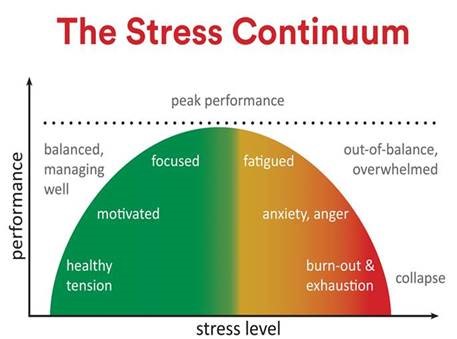
Green Zone (Low-Moderate Stress): You feel motivated. You’re energized. You can focus. This is where peak performance lives — but it’s time-limited. The goal is to stay here as long as possible and then take a break before pushing into the yellow zone.
Yellow Zone (Diminishing Returns): This is where most dissertation writers live. You think you’re working efficiently, but your performance is declining. You feel fatigued, out of balance, or overwhelmed. You’re still producing, but the quality and speed are dropping. This is the point where you need a purposeful break.
Orange Zone (Moderate Burnout): Anxiety and exhaustion are present. Your stress exceeds your coping resources. You’re functioning, but it’s unsustainable. At this stage, self-help techniques alone often aren’t enough — you need to build recovery infrastructure (counseling, peer support, workload adjustment).
Red Zone (Severe Burnout): You’re experiencing depression, anxiety, or exhaustion at a level where functioning is impaired. This is the stage where university counseling services, professional mental health support, and academic accommodations become necessary — not optional.
Shareable Insight
Imposter syndrome isn’t a confidence problem. It’s a structural one. The PhD asks you to produce something nobody has produced before, in isolation, with broken feedback loops. The feeling isn’t evidence that you’re a fraud. It’s evidence that you’re doing hard, novel work.
Stage-by-Stage Stress Mapping — What to Expect at Each Phase
Not all dissertation stress feels the same. Understanding which phase you’re in helps you anticipate what’s coming and choose the right strategies. The Manchester Humanities blog (May 2025) confirmed that stress peaks at transitions — not at the midpoint of work, but at the moments between phases.
Stage 1: Proposal Writing
Stress Level: Moderate
Common Triggers:
- “Am I asking the right question?”
- Uncertainty about whether your topic is viable
- Pressure to convince your committee your approach is sound
- The overwhelming blankness of a proposal document
What Helps:
- Chunk the mountain: break the proposal into 1,000-word daily goals instead of “write a proposal”
- Share drafts with peers early — they’ll confirm that uncertainty is normal
- Use the Pomodoro 25/5 technique for proposal sections where you’re stuck: just start typing, even if the words are bad. Momentum replaces paralysis.
Stage 2: Data Collection
Stress Level: Moderate to High
Common Triggers:
- Unexpected results (your data doesn’t look like what you expected)
- Technical problems with instruments, software, or surveys
- The gap between what you planned and what’s actually happening
- Feeling like you’re behind schedule
What Helps:
- Document problems as they happen. When everything “looks perfect” in the literature review, it creates a false expectation that your process will be smooth. It won’t. Documenting messy data is itself research.
- Communicate with your supervisor about surprises. Most supervisors prefer hearing about problems in February rather than June.
- Adjust your timeline rather than forcing the original plan. Flexibility prevents the panic response.
Stage 3: Writing the Thesis
Stress Level: Highest
Common Triggers:
- The physical weight of producing 100–300 pages of original research
- “Am I writing well enough?” — the imposter syndrome peak
- Chapter-by-chapter fatigue that feels cumulative
- The temptation to start editing Chapter 1 while Chapter 10 is still incomplete
- Comparison with peers who seem to be writing faster or more smoothly
What Helps:
- The Pomodoro technique adapted for thesis writing (more on this below)
- Stop comparing your process to others. Peer publishing habits look smoother because they don’t share the draft chapters.
- Celebrate small milestones: “Chapter 4 is done” is a real accomplishment.
Stage 4: Defense Preparation
Stress Level: High (but time-bound)
Common Triggers:
- The viva/oral exam feels like an interrogation
- Fear of being asked questions you can’t answer
- The pressure of performing in front of examiners
- Final revisions that feel endless
What Helps:
- Practice your defense with peers, not alone. The Clance research (1978) found that peer support is the single most effective intervention for imposter feelings — and defense prep is where it matters most.
- Prepare answers to common questions, not every possible question. You can’t predict what examiners will ask. You can prepare to think clearly.
- Remember: the defense is a conversation about your work, not a test of everything you don’t know.
The Stage-Specific Stress Management Matrix
| Dissertation Stage | Primary Stress Trigger | Best Technique | Red Flag |
|---|---|---|---|
| Proposal | Uncertainty about topic viability | Chunking + peer sharing | Paralysis for 2+ weeks |
| Data Collection | Unexpected results | Supervisor communication + timeline adjustment | Avoiding work for 1+ week |
| Thesis Writing | “Am I writing well enough?” | Pomodoro + wins journal | Cognitive fog + sleep disruption |
| Defense Prep | Performance anxiety | Peer practice + question prep | Physical symptoms (headaches, fatigue) |
Imposter Syndrome: It’s Structural, Not Personal — The 5 Types
You’ve probably heard about imposter syndrome. Most people talk about it as if it’s one feeling with one antidote: “just believe in yourself.” That doesn’t work for long. Hearing it from a peer does.
Academic psychologist Valerie Young identified five types of imposter syndrome, each with a distinct internal script. Understanding which type you are helps you target the specific cognitive distortions driving your doubt. This framework was detailed by Shruti Sharma at Thesis Ace Writers https://www.thesisacewriters.com/blog/how-to-overcome-phd-imposter-syndrome-guide.
The 5 Types of Imposter Syndrome (Valerie Young’s Framework)
The Rugged Individualist“Asking for help means I can’t do it alone”Not using supervisor/peers/services that could helpPeer writing sessions, counseling services, and writing support are tools — not admissions of weakness.The Expert“I don’t know enough to be the expert here”Constant literature review without writing, delaying thesis chaptersYou’re not supposed to know everything.
| Type | Internal Script | PhD Manifestation | Evidence-Based Antidote | ||||||||||||||||||||||||||||||||||||||||||||||
|---|---|---|---|---|---|---|---|---|---|---|---|---|---|---|---|---|---|---|---|---|---|---|---|---|---|---|---|---|---|---|---|---|---|---|---|---|---|---|---|---|---|---|---|---|---|---|---|---|---|
| The Perfectionist | “If it’s not perfect, I’ve failed” | Endless revision, never submitting, crushing self-criticism | Set a submission deadline and keep it. “Good enough” is the goal, not “perfect.” | ||||||||||||||||||||||||||||||||||||||||||||||
| The Superhero | “I must work harder than everyone else” | Working 80-hour weeks, burnout, can’t say no to tasks | Treat the PhD as a regular job (7.5 hours/day). Boundaries protect your output. | ||||||||||||||||||||||||||||||||||||||||||||||
| The Natural Genius | “If I have to try hard, I’m not smart enough” | Avoiding new methods, not seeking help with difficulties | Asking for help is normal research behavior, not a sign of inadequacy. | ||||||||||||||||||||||||||||||||||||||||||||||
| The PhD trains you to know more, not to know it all. |
Why This Matters for Dissertation Stress Management
Most doctoral students are Perfectionists and Experts — endlessly revising, reading, and doubting. Recognizing which type you are lets you stop treating a structural problem as a personal failing. You’re not broken; you’re experiencing a predictable response to an impossible environment.
The most powerful intervention isn’t self-belief. It’s peer sharing. Clance’s original 1978 research found that the feeling loses much of its grip the moment a sufferer hears another high-achiever describe the same experience. If you haven’t talked about imposter syndrome with your peers yet, the first place to start is a room full of people who feel exactly as you do.
Try this today: Open a blank document. Call it “evidence file.” Spend five minutes writing down every concrete piece of evidence you have that you belong on this PhD: the supervisor comment that called your introduction strong, the admissions panel that chose you out of a stack of applications, the conference question you answered well. Save the file. When the feeling spikes — and it will — open it and read it. This isn’t positive thinking. This is evidence-keeping.
Evidence-Based Stress Management Techniques
Now let’s get practical. Here are the interventions that research and doctoral experience support — adapted for PhD timelines, not generic productivity advice.
1. The Pomodoro Technique — Adapted for Doctoral Timelines
The standard Pomodoro technique uses 25-minute work intervals with 5-minute breaks. For undergraduate assignments, this works. For doctoral writing, it often creates more stress than it relieves — constant interruptions to a 25-minute timer shatter the deep focus you need.
Here’s how doctoral writers adapt it:
25/5 intervals: Best for writer’s block, proposal drafting, or when you’re resisting starting. The short intervals reduce the pressure of “write for hours.” Just start typing.
50/10 intervals: Best for deep writing — when you’re in a flow state and need to sustain it. Ten minutes of rest after fifty minutes of writing is long enough to recharge without losing momentum.
90/5 intervals: Best for flow-state work — when you’re deeply engaged with your analysis, literature synthesis, or discussion chapter. Ninety-minute blocks align with the brain’s natural focus cycles.
A thesis writer’s day might look like:
- Morning block: Two 90/5 intervals (3 hours of deep writing)
- Afternoon block: Three 50/10 intervals (2.5 hours of editing, research, or correspondence)
- Late afternoon: Four 25/5 intervals (50 minutes of low-effort tasks: formatting, referencing, inbox)
The NYYTI blog (2022) from a Finnish thesis writer https://www.nyyti.fi/en/time-management-during-thesis-writing/ reported that adjusting to 25-minute sessions worked better than the original 20-minute sessions — and that taking a long break after six Pomodoros (rather than four) suited research work better. The lesson: adapt the technique to your brain, not the other way around.
2. Chunk the Mountain
The Manchester blog’s “chunk the mountain” framing is exactly what it means: take a massive task and break it into pieces small enough that starting feels trivial.
- “Write the thesis” → “Write 500 words about Methodology Section 1”
- “Revise Chapter 3” → “Fix the references in the last two paragraphs”
- “Prepare for defense” → “Practice answering three common questions”
Chunking reduces the cognitive load of starting. You’re not writing a thesis. You’re writing one paragraph. Then one more. Then one more.
3. Treat the PhD as a Regular Job
Dr. Bozward’s advice to treat the PhD as a regular job — not a noble sacrifice — is one of the most liberating things you can do.
- Set work hours: 9 AM to 4:30 PM (or whatever 7.5 hours looks like for you)
- When the clock hits 4:30, stop. The writing will wait. It always does.
- Take one rest day per week. Completely off the thesis.
- Take a real break after major milestones. Don’t rush from one phase to the next.
This isn’t about laziness. It’s about sustainability. Doctoral writing is a marathon, not a sprint. The students who finish first aren’t the ones who grind the hardest — they’re the ones who sustain the longest.
4. Build Peer Support — Not Just for Imposter Syndrome, for Everything
Peer support isn’t a soft extra. It’s the active ingredient of doctoral stress management.
- Find a writing buddy. Share a document. Write near each other.
- Join a departmental writing group. Even if you don’t share chapters, just sitting in the same room with other PhDs reduces isolation.
- Share your progress with someone who won’t judge it. “I wrote 300 words today” deserves a nod, not a critique.
Clance’s research confirmed this repeatedly: hearing that high-achieving peers feel exactly as you do is the single most effective intervention for imposter syndrome. It’s also the most effective intervention for the feeling that you’re carrying the thesis alone.
When to Seek Professional Help — A Decision Framework
You can manage most dissertation stress on your own. But you can’t manage severe burnout alone. Here’s when to escalate:
Self-help only: Green zone stress. You feel motivated, slightly rushed, but functioning well. Pomodoro + chunking + peer support is sufficient.
Self-help + peer support: Yellow zone stress. You’re fatigued but still producing. Add one rest day per week, talk to peers about imposter feelings, and schedule a check-in with your supervisor.
Self-help + counseling: Orange zone stress. Physical symptoms (fatigue, sleep disruption), persistent anxiety, or cognitive fog lasting 2+ weeks. This is when you contact your university’s counseling service — or consider academic writing support.
Counseling + academic accommodations: Red zone stress. Depression, persistent low mood, inability to function. This is when you contact your university counseling center, your GP, and consider taking a medical leave or adjusting your timeline.
Here’s the honest truth: If you’re in the orange or red zone, the world won’t end if you slow down. In fact, slowing down will make everything faster — because you’ll stop burning out and start producing consistently.
If you’re overwhelmed right now: You don’t have to write every chapter of your thesis alone. TopDissertations offers chapter-by-chapter writing assistance, from literature reviews to full thesis drafts, with direct writer communication and plagiarism-free guarantees. Learn more about our order options — or explore our VIP services for enhanced features, priority delivery, and dedicated senior writers.
University Counseling Services: What Actually Exists
Most students don’t know what university counseling services exist. They assume “counseling” means one thing: sitting in an office talking about feelings. That’s only one option.
The University of Bonn’s comprehensive mental health guide maps the specific services doctoral students can access — many of which don’t exist on your radar:
- Psychological Counseling Service: Available at most universities’ Central Study Advisory and Counseling Centers. Confidential, free, and designed for students at exactly the stage you’re in.
- Doctoral Coaching / Doctoral Coaching for Students: Structured sessions focused on your specific academic challenges — not general life counseling, but targeted support for dissertation, research, and supervision problems.
- Ombudsperson Office: An independent advice, mediation, and arbitration service for conflicts in your supervisory relationship. If your supervisor is undermining your confidence, this is a resource — not a failure.
- Psychotherapeutic University Clinic: For students who need clinical-level support. Many universities offer subsidized or free therapy through their psychology departments.
- Psychosocial Counseling Center (PSB): Student-run or student-accessible counseling for difficulties ranging from stress to crisis.
- Stress Management Workshops: Many universities now offer workshops on time management, boundary-setting, and saying “no” without guilt. Check your graduate school or graduate center for upcoming sessions.
How to Access These Services
- Find your university’s counseling center. Search “[Your University] psychological counseling service student” — it’s usually on the student services page.
- Call or email. Don’t wait for the first crisis. Book an appointment when you’re still in the yellow zone, before you reach the orange zone.
- Ask specifically about doctoral students. Many counseling centers have experience with PhD and dissertation stress and can tailor their approach.
- Check your graduate school. Graduate centers often host stress management workshops, peer writing groups, and doctoral coaching.
A Word About Writing Support
Accessing academic writing support isn’t “cheating.” It’s a tool — the same kind of tool you’d use for a lab, a software program, or a statistics package. TopDissertations provides chapter-by-chapter assistance, editing, and full-draft writing from qualified writers who hold BA, MA, and PhD degrees across 60+ disciplines. Explore our order options to see how writing support can help you move forward even when you feel stuck.
You’re Not Broken — You’re in the System
Here’s what I’d choose if I were in your position right now: I’d take a step back from the document, set a timer for 50 minutes, and write 500 words — not because they need to be perfect, but because they need to exist. Then I’d take a 10-minute break. Then I’d do it again. And tomorrow, I’d do it again.
That’s the entire strategy. Not motivation. Not inspiration. Just the next paragraph.
The stress you’re feeling is real. It’s shared by thousands of doctoral students right now. It’s caused by the structural conditions of doctoral work — isolation, novelty, broken feedback — not by anything wrong with you. And it’s manageable, one Pomodoro at a time, one chapter at a time, one conversation with a peer at a time.
If you’re feeling overwhelmed, you’re not alone. If you need help with the writing, we’re here. And if you need to slow down and take a breath — that’s not failure. That’s the only way to finish.
