 TopDissertations


Let me paint a picture you might recognize: It’s 2 AM. You’ve just finished reading feedback from three committee members. Member A says your methodology section needs to completely change the analytical framework. Member B says the original framework is perfect and they don’t understand why the reviewer suggested changes. Member C tells you the entire chapter is too brief. Three members. Three completely contradictory pieces of advice.
If your first instinct is to throw your laptop across the room, I want you to know — that reaction is completely valid. Committee conflict is one of the most anxiety-inducing moments in the dissertation journey. You’re simultaneously worried about:
- Damaging relationships with people who hold significant power over your academic future
- Making the wrong choice and spending months revising in the wrong direction
- Looking like you’re playing committee members against each other
Here’s what I know from talking to dozens of graduate students who’ve navigated this exact situation: conflicting committee feedback is almost always solvable without derailing your timeline. The trick isn’t choosing sides — it’s using the right framework.
Before we dive in, here’s what you need to know:
- Committee members often give conflicting advice because they haven’t all read your work deeply — the contradiction is rarely a personal attack
- The “Both/And” compromise strategy lets you satisfy contradictory feedback by using your Limitations section and footnotes strategically
- Create a feedback matrix (see the template below) to compare feedback objectively before implementing anything
- Follow the 4-step escalation path when informal resolution fails: Chair → Joint Meeting → Ombuds → Formal Grievance
- Document everything with a change log — it’s your political shield against moving goalposts
Why Committee Members Disagree (And It’s Not About Your Work)
Image: Conflicting supervisor feedback visual (Anoosha Mehak / KM AcademicSuccess)
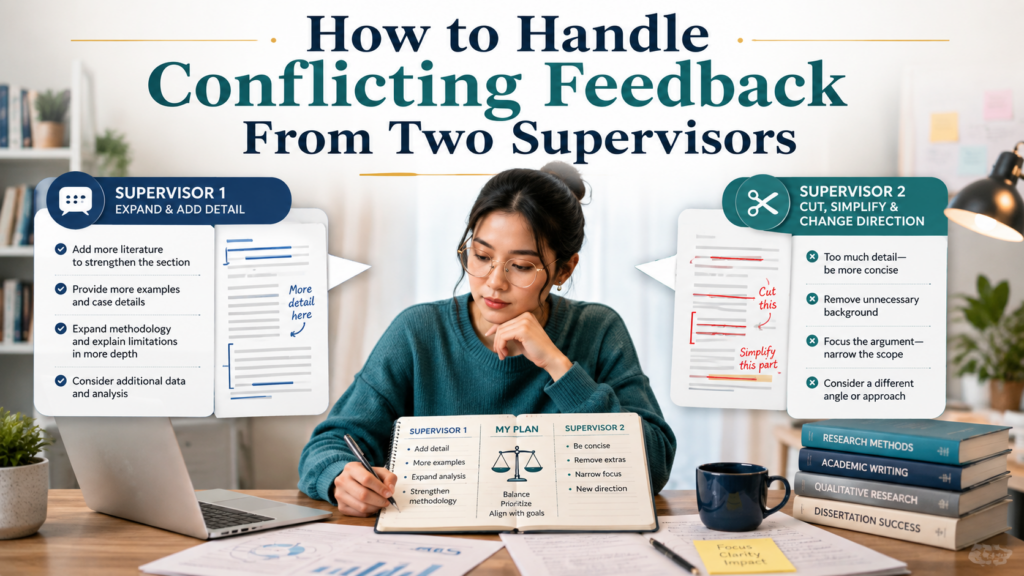
Caption: When supervisors give contradictory feedback, visual comparison helps students identify patterns before making decisions.
Here’s a truth most dissertation guides won’t tell you: your committee members are probably not even fully reading your document.
Dr. Karen Kelsky, writing for InsideHigherEd, documented a pattern called the “greybeard phenomenon” — elderly, soon-to-be-emeritus faculty members who respond to their declining feeling of importance and influence by pitching battles over graduate students [1]. In other words, some committee members contradict each other not because they’ve thoughtfully engaged with your research, but because they’re trying to assert relevance.
This might sound cynical, but consider this: most contradictions in committee feedback are actually symptoms of varying levels of faculty engagement, not genuine methodological disagreements. A faculty member who skimmed three pages might give advice that contradicts a member who read your full chapter. Neither person is “wrong” — they’re operating at different depths of attention.
Recognizing this changes everything. Instead of spiraling into “who’s right?!”, you can treat contradictory feedback as a navigation problem, not a crisis.
The Investment Spectrum
Here’s a framework I use when I evaluate committee feedback:
| Engagement Level | What It Looks Like | How to Handle It |
|---|---|---|
| Deep investment | Detailed, specific comments with page numbers | Implement or negotiate |
| Moderate investment | General suggestions without citations | Consider, then follow chair guidance |
| Minimal engagement | Contradictory to other feedback, vague language | Document, then move forward |
The rule I recommend: If a member’s feedback contradicts another member AND feels vague, defer to the chair’s judgment. You’re not being indecisive — you’re being strategic.
The 4-Step Escalation Path
When informal diplomacy doesn’t work, here’s the escalation sequence university policy actually supports:
Step 1: The Committee Chair
Start here every single time. The chair is your mediator, not your adversary. As the University of Calgary’s graduate student guide explicitly states, “If you receive any conflicting advice or expectations within your supervisory committee, bring the matter to your supervisor” [2]. This is institutional policy, not just informal advice.
The right move: Send a neutral, factual email to the chair summarizing the conflicting feedback and asking how they’d recommend proceeding. Don’t accuse anyone. Just state: “I received X from Member A and Y from Member B, and I’d like your guidance on how to proceed.”
Step 2: The Joint Meeting
If the chair’s guidance isn’t sufficient, request a joint meeting where both committee members can hear each other’s perspective. This is where KM AcademicSuccess’s 15-step framework becomes incredibly useful [3]. The key insight: conflicts often resolve themselves when committee members realize they’re actually aiming at the same destination.
What successful graduates recommend: Come to the joint meeting with your feedback matrix already prepared. Show the members exactly what you’re looking at. This transforms the conversation from “you’re wrong about my work” to “here’s how I’m organizing this feedback.”
Step 3: The Ombuds Office
When the chair and joint meetings don’t resolve the conflict, escalate to your university’s ombuds office. This is the step most students don’t know about, but it’s one of the most powerful resources available to you.
The University of Maryland’s Graduate Student Ombuds Office describes itself as a “confidential, impartial, independent resource for resolving graduate school issues” [4]. The critical detail most students miss: ombuds discussions stay completely off-the-record with no identifying records kept. Unlike a formal grievance, ombuds conversations create zero paper trail.
The International Ombuds Association maintains dedicated resources for graduate students and researchers dealing with academic conflicts [5]. Similarly, the University of Wisconsin’s Graduate School offers formal conflict resolution resources [6].
Step 4: Formal Grievance
This is the nuclear option. A formal grievance creates institutional records, involves hearings, and can fundamentally alter your relationship with the department. Only use this when:
- An ombuds consultation confirmed a policy violation
- A committee member is acting unethically or abusively
- All other resolution strategies have been exhausted
I won’t sugarcoat this: formal grievance processes are exhausting and rarely worth pursuing unless something crosses into genuine misconduct. Most committee disagreements never reach this level.
Feedback Matrix Template
This is the single most useful tool you’ll find in this guide. Here’s how to organize conflicting committee feedback without making impulsive decisions.
The Template
| Issue | Committee Member A | Committee Member B | Proposed Resolution | Rationale |
|---|---|---|---|---|
| Methodology chapter structure | “Use a purely qualitative approach” | “Stick with mixed methods” | Keep mixed methods; add qualitative subsection in Limitations | Mixed methods were approved by chair in Preliminary Proposal; qualitative section acknowledges Member A’s concern without abandoning methodology |
| Literature review depth | “Expand to cover 50+ sources” | “It’s comprehensive as-is” | Add 5 recent (2024-2026) sources to address Member A’s concern | Addresses depth concern while maintaining scope approved by Member B |
How to Use This Template
- Copy this table into a document
- List each conflict in a separate row
- Note exactly what each member said — quote directly
- Write a proposed resolution that tries to find the intersection
- Document your rationale — this becomes your change log
Why this works: When you visualize conflicting feedback side-by-side, patterns emerge that aren’t visible when reading feedback sequentially. Often, you’ll discover that one member is asking for a change you can address through a footnote or limitations statement rather than a full chapter rewrite.
The “Both/And” Compromise Strategy
Here’s the strategy most students miss: you don’t always have to choose between contradictory pieces of advice.
How to Satisfy Both Members
When Member A wants methodological change X and Member B insists methodological change Y is better, use this approach:
- Keep your original approach (Member B’s preference)
- Add a Limitations subsection that explains why Method X wasn’t chosen (acknowledging Member A)
- Add footnotes citing alternative perspectives that Member A recommended
I recommend this strategy whenever:
- Both suggestions are legitimate academic approaches
- One approach is clearly more appropriate for your research questions
- You’re confident in your chosen methodology
This is genuinely underreported in dissertation guides. Instead of treating committee feedback as a zero-sum game, you’re creating space for academic nuance. The Limitations section and footnotes become your diplomatic zone — they acknowledge alternative perspectives without derailing your research design.
Live Meeting Strategies
Sometimes conflict doesn’t arrive through written feedback. Sometimes it happens live during your committee meeting. This is the most stressful scenario, and it’s where preparation matters most.
The Diplomatic Questioning Technique
When a committee member publicly contradicts another member during a meeting, do not take sides. Instead, use neutral, open-ended questions:
- “Could you both elaborate on your concern?”
- “What’s the common goal you’re both trying to address here?”
- “I’d like to hear more about how your suggestions complement each other.”
The goal isn’t to resolve the conflict in real-time. The goal is to buy yourself time to analyze the feedback objectively. Write it all down. Implement nothing until after the meeting.
The “Parking Lot” Rule
When conflict erupts live, propose to the committee: “I’d like to capture both of these points separately so I can address each thoroughly in revision. Would you both agree that I’ll respond to these suggestions in writing?”
This is what KM AcademicSuccess’s framework recommends as step 7 of their process [3:1]. It transforms live conflict into written analysis, where you can use your feedback matrix and make thoughtful decisions.
Change Log: Your Political Shield
Here’s a truth about committee dynamics: feedback goalposts move. A member who praises a section today might criticize the same section next month. Without documentation, you’re always vulnerable to revision requests that you can’t defend.
The Change Log Template
| Date | Section | Feedback Received | Action Taken | Member Informed | Notes |
|---|---|---|---|---|---|
| 2026-03-15 | Chapter 2 (Lit Review) | Member A wants 15 additional sources | Added 5 recent sources; documented additions in footnotes | Yes | Member A acknowledged additions |
| 2026-03-20 | Chapter 3 (Methods) | Member B wants qualitative expansion | Added 3-page qualitative subsection | Yes | Used Both/And strategy |
This is borrowed from software engineering version control. You’re documenting exactly what feedback you received, what you implemented, and whether you informed the member. This protects you from “moving goalposts” and provides a clear paper trail [7].
What I always tell students: A change log isn’t bureaucracy — it’s your insurance policy. If a member suddenly claims you ignored their feedback, you have the paper trail to prove exactly what you did.
When to Escalate: University Resources
If your committee conflict has reached the point where informal strategies aren’t working, your university likely has confidential resources designed exactly for this scenario.
University Ombuds Offices (What They Do and Don’t Do)
| Resource | What They Offer | Confidentiality Level |
|---|---|---|
| University of Maryland Ombuds Office | Impartial mediation, guidance on graduate school policies | Strictly confidential; no records kept |
| University of Wisconsin Ombud | Conflict resolution through Graduate School | Confidential; limited documentation |
| University of Chicago Ombuds | Grievance guidance, mediation | Confidential; off-the-record consultations |
| International Ombuds Association | General resources for academic conflicts | Varies by office; generally confidential |
Critical distinction: Unlike formal grievances, ombuds consultations create no institutional record. You can explore options freely without triggering any administrative process. This makes ombuds offices the safest place to start when you’re unsure whether a conflict is normal or serious.
University Policy Resources
The University of Calgary provides explicit institutional guidance on escalating conflicting committee advice [2:1]. Their graduate student guide is one of the most comprehensive policy documents I’ve seen on this topic.
Summary + Next Steps
Here’s what I’d choose if I were in your shoes right now:
- Don’t implement any feedback yet. Take a full 24 hours before acting on contradictory advice.
- Build your feedback matrix. Copy the template above and fill it out for every conflict.
- Try the “Both/And” strategy first. Use limitations sections and footnotes to satisfy contradictory feedback.
- Send the chair a neutral summary email. Document the conflict and ask for guidance.
- Only escalate to ombuds if Steps 1-4 fail. You have confidential resources you won’t use unless absolutely necessary.
The single most important takeaway: Your committee’s disagreement is probably about faculty dynamics you can’t see — not about your research quality. Treat it as a logistics problem, not a crisis.
Related Guides
- PhD Thesis Writing Guide — Understanding the full thesis writing process and committee expectations
- Dissertation Literature Review Help — How literature reviews feed into committee feedback cycles
- Dissertation Outline — Creating structured outlines that prevent ambiguous committee feedback
References
-
Dr. Karen Kelsky, “When Committee Members Disagree,” InsideHigherEd (GradHacker), 2012. Available at: https://www.insidehighered.com/blogs/gradhacker/when-committee-members-disagree ↩︎
-
University of Calgary, “Best Practices and Guidelines” — Faculty of Graduate Studies. Available at: https://grad.ucalgary.ca/current-students/thesis-based-students/best-practices-and-guidelines ↩︎ ↩︎
-
Anoosha Mehak, “How to Handle Conflicting Feedback From Two Supervisors,” KM AcademicSuccess, 2026. Available at: https://kmacademicsuccess.com/how-to-handle-conflicting-feedback/ ↩︎ ↩︎
-
University of Maryland, “Graduate Student Ombuds Office.” Available at: https://gradschool.umd.edu/ombuds-office ↩︎
-
International Ombuds Association, “Resources for Graduate Students and Researchers.” Available at: https://www.ombudsassociation.org/resources-for-graduate-students-and-researchers ↩︎
-
University of Wisconsin, “Conflict Resolution Resources,” Graduate School. Available at: https://grad.uw.edu/resource_type/conflict-resolution ↩︎
-
KM AcademicSuccess, 15-step framework for feedback comparison and documentation (2026). ↩︎
